
Inside Secrets Blog
VitalQuant seamlessly connects the expertise of Wall Street strategy design professionals with the needs of independent investors. Our team actively contracts with experienced Quantitative Researchers to share their most effective investment strategies. Our "Inside Secrets Blog" documents their investment insights in plain language.

Why is Compounding the "Engine" of Wealth Creation?
Understanding the difference between simple and compound interest is at the absolute core of successful investing. While they might sound similar, the mathematical outcomes over time are worlds apart.
Simple vs. Compound Interest: The Definitions
To understand why compounding is so powerful, we must first define the two ways your money can grow:
The Power of the "Snowball": A 20-Year Comparison
- Simple Interest: Interest calculated only on the initial principal (the original amount you deposited). Your earnings stay flat every year because you aren't earning interest on your interest.
- Compound Interest: Interest calculated on the initial principal plus all the accumulated interest from previous periods. This creates a "snowball effect" where your money grows faster every single year.
Let’s look at what happens to a $10,000 investment at a 7% return over 20 years:

The Verdict
By choosing compound growth instead of simple interest, the investment grows to nearly 60% more wealth over the same period — without adding extra work or additional capital.
This is the true power of compounding:
After year 1, your money begins working for itself to build itself
Arithmetic vs. Geometric Growth
The secret to compounding is that it shifts your wealth from arithmetic to geometric growth.
- Arithmetic Growth (Addition): 200, 400, 600, 800, 1,000... (Adding $200 each time).
- Geometric Growth (Multiplication): 200, 400, 800, 1,600, 3,200... (Doubling each time).
In the stock market, your returns accrue geometrically. This is why it is critical to reinvest your dividends. When you reinvest, you increase the base amount upon which you earn interest, accelerating the geometric climb. Compounding is a function of time. The longer you leave the "snowball" to roll, the more massive it becomes.
Time: Your Biggest Asset
The 40-Year Horizon (Age 25 to 65):
If you save $10,000 per year with an average 10% annual return:
- Total Principal Invested: $400,000
- Final Account Value: $4,868,518
By consistently contributing and allowing interest to compound, a total investment of $400k turns into nearly $5 million.
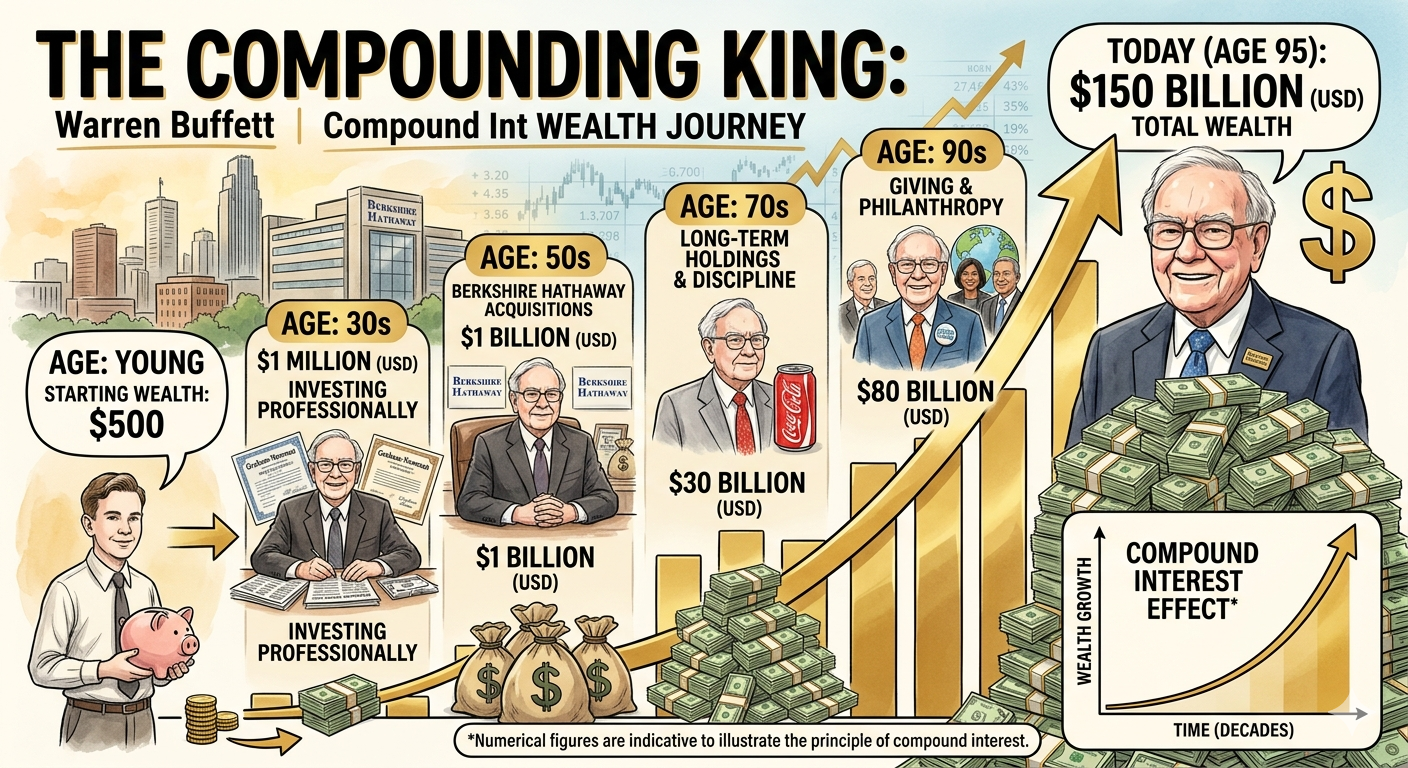
Real-World Inspiration: Warren Buffett
Compound interest is how Warren Buffett transformed a modest start into a global empire. Starting with just a few hundred dollars of his own money in his early 20s, he focused on steady, long-term compounding. Today, decades later, his net worth is measured in the billions. He didn't just work for his money; he let his money work for him through the magic of time and compounding.
How to Make Compounding Work for You
- Start NOW: Every year you wait is a year of "peak" compounding you lose at the end of your life.
- Reinvest Everything: Don't spend your dividends or interest; let them stay in the account to grow your principal
- Seek Higher Steady Returns: While the market averages 10%, higher steady returns can slash your time to retirement in half.
Note: If you can achieve a steady 20% return starting in your early 20s, you could potentially retire in just 20 years (by age 45), rather than the traditional 40-year grind.
At VitalQuant.com, we focus on systematic investment models designed to seek steady, exceptional returns while managing the risks of market recessions.
The math is simple: The earlier you start, the less you have to work.

VitalQuant provides individual investors with institutional-grade investment strategy signals at an affordable price. Profit from Wall Street institutional-grade strategies today.
.svg)
.svg)
.svg)
.svg)